Why you should study at SAW

SAW is a place like no other in the American comics world right now.

A fully functioning two-leveled studio (see the panorama of activity below); a stocked library of inspiration, reference and history; a risograph printing station; and first-rate instructors full of knowledge, talent, experience and generosity of spirit.

SAW Panorama

At SAW we teach more than comics and graphic novels. SAW is a place you can come for a week or a year and forge your personal creative path in visual storytelling.

Our students in 2012-2013 made hundreds of pages of story and artwork, co-curated more than a dozen art shows, collaborated with dramatists and comedians to create original theater, printed and bound thousands of copies of books, attended festivals; worked for clients; and learned in close proximity from our staff of working artists.

Persephone by Sally Cantirino

Untitled


Spring 2013 Mini  Comics

“I’d say I left SAW feeling like I got so much more than I expected or understood I would get. I got a deep, personally catered fine art education in the fundamentals that can push my own work and style forward.”  -  Jared Cullum, week-long participant.

Your school and curriculum are fantastic…I honestly feel far more capable of writing something worth reading after a few classes … Also, Justine being so harsh is perfect. She actually teaches and builds on ideas. – Mike King, Philladelphia

See more testimonials HERE.

Read about our Year-Long Program HERE

Our Visiting Artist Workshops HERE

And our Week-Long Low-Residency Program HERE

Share

Have fun making comics March 25 and 26 with Pat Aulisio (and others!)

Comic making is often thought of as a cartoonist working alone, slaving over pages for hours on end with no connection to the outside world for months at a time while they work on a personal comic book masterpiece. WHO SAID CARTOONING HAS TO BE SUCH A SOLITARY MEDIUM??

I, Pat Aulisio, as organizer of the philly alt comic con for 3 years (and philly santoro con for 1) and editor of numerous anthologies (including math fiction 3D, rub the blood, secret prison 666, marvel comics presents 6), along with Box Brown, publisher of over a dozen and counting cartoonists under Retrofit Comics, and Josh Bayer, editor of over 100 artists for Suspect Device and organizer of the multiple readings that go along with it, are hear to tell you COMIC BOOKS ARE FOR FRIENDS.

We will be giving a talk to help you cultivate and maintain a thriving comic book scene amongst your friends, tips on organizing comic gatherings, editing books, working with other cartoonists to help them reach their full potential and most of all HAVING FUN WHILE MAKING COMICS.

Along the way we will show you numerous drawing games and practices that lead to fully realized comic books, talk about different formats and sizes to publish both in print and on the web, and of course we will be there to make friends with everyone who joins and draw with you.

PAY WHAT YOU WANT to come to SAW, make new and exciting comics, share ideas, and make new friends!

Read more about this event here.

or go to the FACEBOOK INVITE HERE

Share

More about the Memorial Day Weekend Comics Workshop

The workshop will be about appropriation and tradition as well as collaboration. In a sense when Crumb steals from Bud Fisher or Box borrows a surfer from Pettibon or i start to emulate Pat’s background patterns or draw women based on a look I gleaned from Jackie Ormes ( http://www.jackieormes.com) its an extension of the community of comics and the interpersonal relationships which drive the soul of the indie comics community.

We will be doing a lecture based on different swipes we use and other people use, and then doing some exercise that makes people do their own swipe exercises. Maybe we’ll do a Milt Gross shading exercise for example to get people loosened up. I was thinking of making people do a single panel gag/ political cartoon where they draw a demon or an industrial era robot threatening civilization- basically a Political cartoon that isn’t necessarily topical.

Then we’ll break people into different groups and find new ways for them to collaborate , a big project that we haven’t decided upon yet. so the theme will be collaboration, learning from responding to those around you, and also being willing to learn from historical figures- those cartoonists are your “friends” too.

————-

Memorial Day Weekend: Saturday and Sunday, May 25 and 26 11:00am – 5:00 pm.

Philadelphia comics stars Pat Aulisio and Box Brown with  Suspect Device maestro Josh Bayer are coming to SAW for a Memorial Day Workshop full of Raw Power!

This class will be 2 days and will feature a variety of small exercises, collaborative projects and printing. Come for 2 hours or 2 days and pay-what-you-can.

Join us! The facebook event is here:  https://www.facebook.com/events/574404775924575/


Share

SAW Final Week.

Our final week at SAW, big push on finishing comics and booklets, a final show and commencement party. Thanks to everyone at SAW for a great year!

Final Days of SAW 2013-2014
Final nights work!

Final Days of SAW 2013-2014
Risograph emergency!

Final Days of SAW 2013-2014
Setting up the final show


The final publications

Final Days of SAW 2013-2014
The final show.

Final Days of SAW 2013-2014

SAW Graduation

How the Fog Came by Anna Mack
Anna Mack’s How The Fog Came

SAW Graduation
Commencement party on Lake Newnan.

Final Days of SAW 2013-2014
Super SVA Teacher and artist Keith Mayerson delivering a rousing commencement speech

Final Days of SAW 2013-2014
Brilliant Mimi Pond delivering a talk about editing, keeping focus and fighting the demons! Mimi’s telling a story now 35 years in the making!

Final Days of SAW 2013-2014
The graduating class with Tom and Justine.

Share

Collaborative Comics Workshop with Josh Bayer, Pat Aulisio and Box Brown May 25, 26

Memorial Day Weekend: Saturday and Sunday, May 25 and 26 11:00am – 5:00 pm.

Philadelphia comics stars Pat Aulisio and Box Brown with  Suspect Device maestro Josh Bayer are coming to SAW for a Memorial Day Workshop full of Raw Power!

This class will be 2 days and will feature a variety of small exercises, collaborative projects and printing. Come for 2 hours or 2 days and pay-what-you-can.

Share

SAW Micro-grant awardees for April 2013

We here at the Sequential Artists Workshop are extremely happy to announce our two awardees for the SAW Micro-grant for April 2013.

The two awardees, decided upon by our five judges from a pool of several dozen applicants are Alabaster and Asher Z. Craw. 

Each will receive a check for $250 from SAW for their projects.


Alabaster


Alabaster has wowed readers since her days at School of Visual Arts, and especially with her last collection, Talamaroo, a gorgeously packaged collection that wowed everyone who saw it.

She wins for her project-in-progress, Mimi and the Wolves. Where Talamaroo was a delightful, fuzzy primal romp through body, ego and desire, Mimi and the Wolves shows Alabaster pushing her storytelling into deeper territory, using both symbolic and clean child-like imagery to explore a story of a girl haunted by dreams of… well, she’d rather not say. Alabaster plans on releasing Mimi for TCAF. Look for it.


Asher Z Craw

Asher wins for Zebadiah, “An alternative reality autobiography….It chronicles the soul of Zebadiah Howard before and after it is possessed by the devil, then placed in the body of Asher Z Craw fifteen years later.”

In a time when it seems hard to be original, the best route to originality seems to be: keep your heart open and use what tools you can to try to see what’s it telling you. Asher Craw seems to be on this path. Zebadiah is a strange, quiet work, a personal myth about losing one’s soul, and trying to stay connected to the ones you love. He has studied at the IPRC in Portland, Oregon and has recently been awarded something or other at that city’s Gridlords event (sorry- we’re on the East Coast so transmissions are hazy.) On top of that, his ancillary work, Dream Guide and Take a Picture demonstrate a desire to experiment, and tune the dials of his existence until something comes into focus. Look for issues two and three, out soon.


Honorable Mentions

Ingrid Rios : for her story-in-progress, “Bare Bones” about living with an eating disorder. While the subject matter perks the ears, it’s Ingrid’s drawings that compel the reader to understand more. This is brave, raw work, and we are interested to see more.

Aaron $hunga – Cabeza : Clearly influenced by Tsuge and other alternative manga. Interesting, odd and eerie.

Mara Sternberg is editing a book - On Nights Like This, an anthology by survivors of sexual abuse, assault, or rape.

Jared Morgan – True Kvlt: “It’s a love-letter to everything that was taboo when I was younger: heavy metal, horror movies, indie comics, etc.”

Mari Naomi‘s memoir called “Turning Japanese”, a proposed 250-page book about living in Japan and being a Japanese “hostess” is something to look for when it comes out.

We were all fans of the visual material, seen here in Keren Katz’ The Night Poetry Class in Room 1001 but couldn’t get a handle yet on the story material, so we are eager to see more.

The same is true of Craig Marshall’s work, seen here.

Lara Antal  Tales of the Night Watchman

We also received interesting work by Dre Grigoropol, Jenna Brager, Bob Oxman,  and Sophia Wiedeman.

To our applicants not listed above. Thank you for submitting, and your exclusion could be because we didn’t understand your package (a large number of submissions were surprisingly difficult to parse, or we didn’t see the value that you see in it, yet (note the emphasis on yet), or that we are just a bunch of jerks. Know that if you follow your and honor your muse, if you are open and generous to your work and revolutionary in your observations, then you are bettering the world and we support that.

Congratulations to all the awardees and honorable mentions above.

Next round will feature an August 15 2013 deadline for a Sept 15 review. Applicants listed above will not be eligible until our April 2014 round.


Share

Scenes from the SAW Sketch Night

SAW Sketch Night was a terrific event. Hosted at the Acrosstown Repertory Theater and co produced and directed by Tom and Sheila Bishop of crookedletter . We had a great time drawing for our fabulous actors Dan Kuhn and Carolyn Salt, working with them, giving them ideas and prompts, listening to them and combining our skills and forms. Below is some pictures. Come back next year for SAW Sketch Two!

SAW Sketch Night 2013
Carolyne addresses some angry stowaway cats on a trip to Zimbabwe.

SAW Sketch Night 2013
Sally draws as Sheila moves

SAW Sketch Night 2013
Switch up: Adrian moves with Carolyne drawing

SAW Sketch Night 2013
Eric distracting Dan at the Zen Monastery of Peace
.

Share

Recommended Books

I’ve had some requests for booklists for learning comics. I posted this list in 2006. I’ll update it later but for now, here it is:

Recommended Books

WRITING first, then
COMICS and CRAFT


Peter Elbow: Writing Without Teachers

“The core of Elbow’s thinking is a challenge against traditional writing methods. Instead of editing and outlining material in the initial steps of the writing process, Elbow celebrates non-stop or free uncensored writing, without editorial checkpoints first, followed much later by the editorial process. This approach turns the focus towards encouraging ways of developing confidence and inspiration through free writing, multiple drafts, diaries, and notes. Elbow guides the reader through his metaphor of writing as “cooking:” his term for heating up the creative process where the subconscious bubbles up to the surface and the writing gets good.”

Mamet, David

On Directing Film

Penguin USA (Paper); ISBN: 0140127224

Bold , straightforward and maybe shortsighted book on making a film, from the idea to the “shot list”, which Mamet refers to as the linchpin that a movie is going to be made from. Their is no better description (told in essay form and also transcribed dialogues with his students) of how to proceed from an idea to a nononsense visual, dramatci rendtion of that idea. The book is a perfect expression in its goal to outline the thinking steps involved in planning out a scene or series of scenes. Where Mamet falters, in my opinion is his dismisall and disreagrd of film as a VISUAL, EXPRESSIVE medium. For Mamet, all the expression lies in the script and in the SHOT LIST. Even his use of actors (as people who just get up, hit their marks and say their lines and shut up) is extreme. Nonetheless, he is completely selfassured of his points of view, and in learning his method of outlining a scene before beginning the filming or drawing, I can’t imagine a better explication.

John Gardner: The Art of Fiction

Review:

“The Art of Fiction is a ‘how to’ guide for the neophyte who wants to sharpen his writing skills. Its author, the late John Gardner, was not only an accomplished writer but a teacher as well, having been a veteran of many a fiction workshop. Gardner’s teaching experience led him to concentrate on technique as a means to successful fiction writing. His book is a collection of do’s and don’ts for the young writer, supplemented with examples of the right and wrong ways of writing. Above all, Gardner believed that practice makes perfect, and he has included numerous writing exercises for those who wish to improve. Gardner may be naïve in concluding that anyone who wants to write can, but his optimistic teaching approach is infectious and is sure to encourage those who until now have been too shy to try.” Reviewed by Daniel Weiss, Virginia Quarterly Review (Copyright 2006 Virginia Quarterly Review)

Milan Kundera: The Art of the Novel

From the publisher: “Kundera brilliantly examines the work of such important and diverse figures as Rabelais, Cervantes, Sterne, Diderot, Flaubert, Tolstoy, and Musil. He is especially penetrating on “perhaps the least known of all the great novelists of our time,” Hermann Broch, and his exploration of the world of Kafka’s novels vividly reveals the comic terror of Kafka’s bureaucratized universe. Kundera’s discussion of his own work includes his views on the role of historical events in fiction, the meaning of action, and the creation of character in the postpsychological novel. His reflections on the state of the modem European novel are as witty, original, and far-reaching as his fiction.”

I was most thrilled by his constant discussion of polyphony, that is, the novel structured like symphony, of many threads and movements working in concert.

Kenneth Atchity: A Writer’s Time

There are so many great things about this book. It gives the best convincing case for the two poles of creating: the wild, loose, surprising subconsicous side, and the smart, editorial side. It gives you tools to access both at the right time. He adds tools to construct narratives and finally covers organizing one’s time on a project. Indispensible.

For A New Novel by Alain Robbe-Grillet

“Here is a collection of critical essays about the so-called New Novel, the quite frankly bizarre genre that sent shockwaves through the French literary community back in the ’50s, as interpreted by one of its foremost practitioners. Anyone who found themselves gazing blankly at the pages of Robbe-Grillet’s “Jealousy” will at least get a general idea of the New Novel from this book.” (Amazon customer)

That review sucks. Robbe-Grillet says, why is a novel always about character and setting and conflict? Isn’t it about language? Isn’t our human symbology deeper than our previous novels have allowed us to be? What do words mean? What does a chair mean? What does a shaft of light mean? What do words describe. What does it mean to the reader?

Read this book! What are you- chicken? – TH

Volger, Christopher

The Writer’s Journey: Dramatic Structure for Storytellers

ISBN: 0941188701

Overview of Joseph Campbell’s “Hero’s Journey” ideas and their use in Hollywood storytelling. Though simplistic, it is surprisingly useful if used correctly, meaning not as formula, but as dramatic tools. Outlines a series of 12 steps in many stories exemplified by Wizard of Oz but also evident in Titanic and surprisingly, even Tarentino’s Pulp Fiction. Though personally, I think comics are much more than dramatic stories told with pictures, it does a good job of cracking open the traditional story structure and peeking inside. You can see the effects of this kind of thinking, if not the book itself, in some of the best and worst films out there.

Campbell, Joseph

The Hero with a Thousand Faces

campbell: ISBN: 0691017840

Seminal and definitive look at world mythology and the “shared stories” therein. From African mythology, to Norse, to American Indian, the elements of myths are often similar. Campbell outlines these and as such, furthers Jung’s mapping of humanity’s unconscious hopes, desires and fears.

Egri, Lajos

The Art of Dramatic Writing

ISBN: 0671213326

A seminal 20th century book on playwriting, and the introduction to the “dramatic statement” inherent in any play, the book is very instructive in looking at the elements of your story and examining which are contributing to the greater theme, and which are not. Like David Mamet’s book, it has little room for other opinions of how drama is constructed but certainly presents its own thesis cearly and completely.


COMICS and CRAFT


Blackbeard, Bill :

Smithsonian Collection of Newspaper Comics

ISBN 0874741726

Essential introduction to the comic strips of the early 20th century.


L’ Association Editors:

Comix 2000

Essential cross section (2000 pages) of silent comics from across the globe. Countless examples of innovative silent storytelling .

Chelsea, David

Perspective for Comic Book Artists

ISBN 0823005674

Both an introduction and comprehensive course in perspective tailored specifically for Comic Book artists (and told in comics form.) People that don’t know persepctive will finally learn what they’ve been doing right. Even those that think they know perspective will probably walk away with their heads spinning and full of new insights. Exhaustive and somewhat confusing if you don’t want to do the math.

Scott McCloud

Understanding Comics

Kitchen Sink Press; ISBN: 006097625X

Comprehensive examination of the mechanics of the art form; from an examination and mapping of iconograph imagery to an new nomenclature for transistions between comic panels (and a mapping of those as well.) Great overview and introduction to the intellectual tools involved in creating comics.

Eisner, WIll

Graphic Storytelling

Poorhouse Pr; ISBN: 0961472820

From the publsiher: “A companion to Comics & Sequential Art, this book takes the principles examined in that title and applies them to the process of graphic storytelling. Eisner shows comic artists, filmmakers and graphic designers how to craft stories in a visual medium. They’ll also learn why mastering the basics of storytelling is far more important than the hollow flash and dazzle seen in lesser work. Readers will learn everything from the fine points of graphic storytelling to the big picture of the comics medium, including how to: * Use art that enhances your story, rather than obscuring it * Wield images like narrative tools * Write and illustrate effective dialogue * Develop ideas that can be turned into dynamic stories These lessons and more are illustrated with storytelling samples from Eisner himself along with other comic book favorites, including Pulitzer Prizewinner Art Spiegelman, Robert Crumb, Milton Caniff and Al Capp. ”

Eisner, WIll

Comics and Sequential Art

Poorhouse Pr; ISBN: 0961472812

Taken from Amazon.Com reader reviews: “Written years before Scott McCloud’s “Understanding Comics,” Eisner expounds upon how comics are a visual, reading experience using both words and pictures. He instructs the reader in how words and pictures can be used together to tell a story. The author must lead the reader with visual clues to each sequential immage. Mood, emotion, even time can be expressed visually in a comic. Camera angles, panel borders, typefaces, all play a part in the effectiveness of a story.

Eisner gives plenty of examples of his work to illustrate his ideas. Most significant are his “Hamlet,” “Life on Another Planet,” and several “Spirit” works. Looking at this really helps the reader see how creatively a story can be told.

Also included in this book are examinations of the various types of work a comic illustrator can do, including storyboards and instruction manuals.

This book, and its sequel “Graphic Storytelling,” are must reading for anyone who wants to create comics, and good reading for anyone who wants to understand them better.

Martin, Gary

The Art of Comic Book Inking

ASIN: 1569712581

Pretty good introduction to inking tools and concepts/. Especially good and identifying methods of implying shade and wreight on a human figure. A number of variations on the same pencils by differing comic book inking pros offers a good look at many ways a page can be successfully inked.

Matt Madden: 99 Ways to Tell a Story

Review:

“Retelling the same one-page comic 99 different ways sounds boring, but Madden, a leading proponent of the value of formalist exercises, demonstrates how well boundaries can drive creativity, inspired by the similar work of Raymond Queneau. A new discovery awaits the reader on every page. The basic scene is a nonstory about a man who forgets why he’s looking in the refrigerator. In the variations, new elements are introduced and removed: different characters, more panels, fewer closeups, flashbacks, text-only or a focus on sound or color effects. Madden acknowledges the history of the medium with allusions to various genres and characters (including the Yellow Kid, Krazy Kat and Winsor McCay’s Rarebit Fiend). Favorites include a how-to on building a comic, a palindromic story that reads the same backward and forward, and a calligram (with text formed into a question mark shape). The book’s format is ideal, with each page of comics facing a small identifying label, so approaches don’t compete with each other, yet pages placed in sequence add up to another narrative. Anyone interested in comics or storytelling will learn much about the interaction between format and content through comparison of Madden’s many ingenious approaches.” Publishers Weekly (Starred Review) (Copyright Reed Business Information, Inc.)

Go Matt!

Share

What’s Happening at SAW Soon: programs, classes, workshops, shows

Visual Technique and Mastery with Justine Andersen

Thursdays April 4-May 9, 6:30-9:00 pm

Justine’s plan: Throughout the course of the class I will be taking you (the students) through each of the steps I took to go from start to finish (from composition to symbolism, from pencils and inks to final watercolors), and over the 6-week course YOU will be creating finished full color illustrations, guided one step at a time by me! This class will be more comprehensive and more focused on the end result than most of my practice and technique-heavy classes. At the end of the 6 weeks you will have something finished to show for your time!

Thursdays beginning April 4 – May 9, 6:30-9:00 pm.

Facebook event for the class here

More info and sign up here

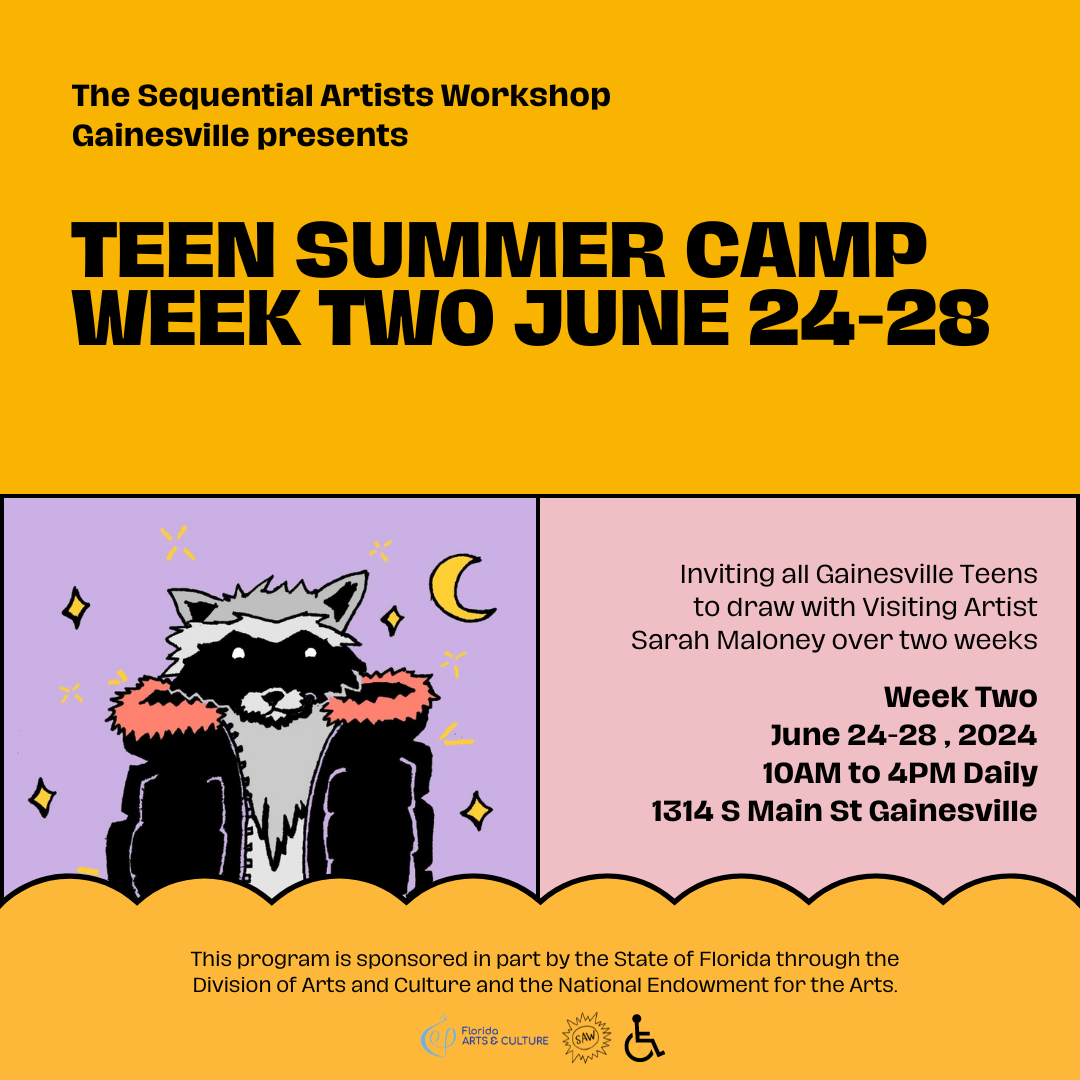
Teen Class in the Summer.

TEEN COMICS CREATION WORKSHOP
June 17-28 at SAW

Learn more here 


SAW Sliding-Scale Low Residency Week

May 6-10, 2013

Our low-residency week will be May 6-May 10. Come to SAW for one week to study with our faculty in a curriculum designed specifically for you and the other students.

$200-400 (sliding scale) for the Low-Residency week at SAW, which will be Monday May 6 – Friday May 10, from 11-5 each day. The curriculum will consist of detailed workshopping and precise exercises designed to benefit our specific student body. Each of our three core instructors will guide at least one day’s workshop, and we will bring in other artists and influencing mentors where needed.

Learn more or sign up here.

Accepting applications for our Single-Year Program, 2013-2014. Click here

SAW Sketch Night

Sunday April 21!

Join the artists of SAW and a selection of Gainesville’s finest stage improvisors at the Acrosstown Repertory Theater as they combine skills in a night of fun story-building, beauty and possible chaos. There will be live drawing, skits, improv performances, and combinations of the three.

7:30-9:00 pm

Sliding scale from $5-$20. Proceeds to benefit SAW and local performers.

Facebook event here

COMICS ARE DOPE!

MEMORIAL DAY WORKSHOP WITH JOSH BAYER, PAT AULISIO, and BOX BROWN

Join Philadelphia star Pat Aulisio, Retrofit publisher and crazy wrestling fan, Box Brown and Rob Clough’s “Cartoonist of the Year”, Josh Bayer in an intensive 2 1/2 -day collaborative workshop. May 25-27. Details here.
Share
WordPress theme: Kippis 1.15